In recent years, a growing number of overseas Chinese families and cross-border entrepreneurs are no longer relying solely on traditional Western permanent residency status. Although many have lived in Europe, America, Australia, or Canada for years and already hold valid green cards or PR status, they are actively adding Singapore residency as their optimal second citizenship and residency solution. This trend is not accidental but a rational response to tightening global taxation policies, strict immigration residency rules, and increasingly fragmented cross-border business environments.
Most overseas Chinese face two major dilemmas with their existing Western residency status: strict physical residency requirements and global taxation obligations. Countries such as Canada, Australia, the United States, and the United Kingdom enforce mandatory immigration supervision days. If overseas Chinese business owners need to travel frequently back to China or operate cross-border businesses in multiple regions, it becomes extremely difficult to meet local residency requirements. As a result, their long-held PR status faces suspension or cancellation risks, creating huge uncertainty for family settlement and asset layout.
In terms of taxation, traditional Western countries implement global taxation systems. Once holding local PR or citizenship status, individuals must declare worldwide income, including domestic business profits, overseas investment returns, real estate income, and equity dividends. For cross-border Chinese entrepreneurs with complex asset structures and multi-region revenue sources, full declaration brings extremely high compliance pressure and potential audit risks. Minor omissions may lead to fines, tax records, and even long-term immigration reputation impacts.
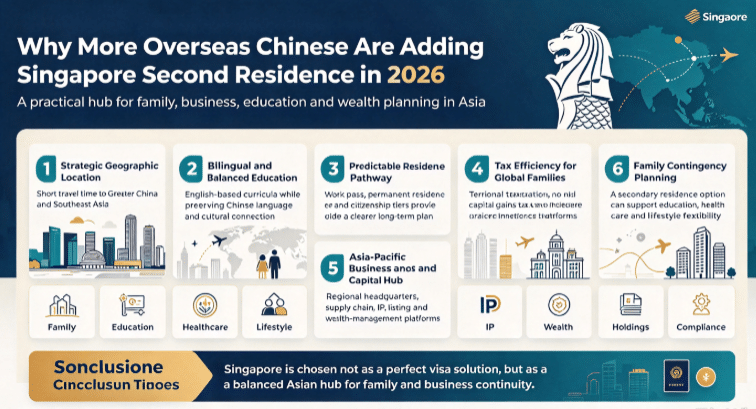
Singapore perfectly solves these core pain points for overseas Chinese. First, Singapore has no mandatory immigration supervision days for EP and PR holders. Overseas Chinese applicants can retain their Singapore residency legally while continuing to operate global businesses and travel frequently between China, Europe, America, and Southeast Asia. There is no need to sacrifice business development for identity retention.
Second, Singapore adopts a territorial taxation system. Only income generated locally is taxable. Legitimate overseas income and offshore profits do not require double taxation or repeated declaration in Singapore. This policy greatly optimizes the global tax structure for overseas Chinese businessmen, effectively reducing long-term tax compliance risks and making Singapore a reliable global asset safe haven.
In terms of family education, Singapore’s bilingual education system fills the biggest gap in Western education for Chinese families. Children studying in pure Western education systems often lose their Chinese language and cultural foundation, making it difficult for them to adapt and develop in China in the future. Singapore’s English-first and compulsory Chinese education model allows children to integrate into international elite education while maintaining Chinese language advantages, enabling them to freely choose to develop in China, Europe, America, or globally in the future.
In addition, Singapore’s geographical proximity to China, zero time difference, convenient air routes, and Chinese cultural environment greatly reduce the adaptation cost for overseas families. For overseas Chinese who have been drifting globally for a long time, Singapore is not only a business hub for cross-border layout but also a stable family backup base.
Different from Western immigration, Singapore residency is superimposable and does not require abandoning existing overseas status. It is the most flexible and safe second identity solution for overseas Chinese in 2026. If you are an overseas Chinese family or cross-border entrepreneur troubled by immigration supervision and global taxation, consult Mayson to customize an exclusive Singapore residency optimization plan.
FAQ
Q: Can I apply for Singapore EP while holding Canada or Australia PR? A: Yes, Singapore allows multiple residency statuses with no conflict or restriction.
Q: Do I need to stay in Singapore frequently to maintain residency? A: No mandatory residency days, only stable business or family connection maintenance is required.