One of the biggest advantages of Singapore immigration recognized by global families is its flexible residency policy. Unlike many European and American immigration countries that require strict annual immigration监 days, Singapore has no mandatory residency requirements for PR holders. However, a large number of PR holders misunderstand the policy and mistakenly believe that Singapore PR is permanently valid regardless of living records, which leads to REP renewal failures and even the loss of permanent resident qualifications.
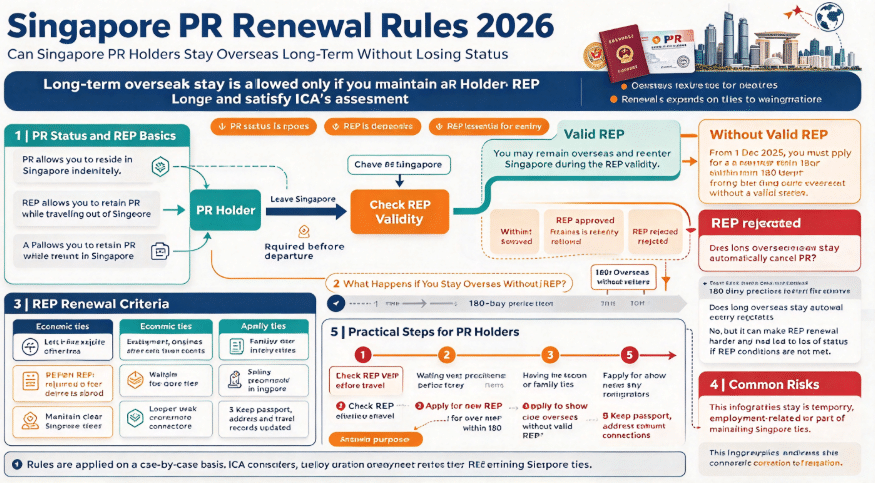
To clarify the official rules in 2026: Singapore PR status is permanent in theory, but the REP (Re-Entry Permit) is valid for only 5 years and must be renewed regularly. If the REP expires and cannot be renewed successfully, the PR holder will lose the right to freely enter and exit Singapore, and in severe cases, the PR identity will be cancelled. The core assessment standard for REP renewal is not the number of residence days, but the long-term connection between the applicant and Singapore.
ICA’s 2026 REP renewal assessment focuses on three key connection indicators. The first is family connection. If the applicant’s spouse and children continue to study, work, and live in Singapore, and maintain local residential records, the renewal success rate is extremely high. The second is economic connection. Holding Singapore company shares, local assets, continuous tax records, or stable local business operations can effectively prove the applicant’s economic contribution to Singapore. The third is living and social connection. Maintaining reasonable entry and exit records, local consumption, and social activity traces can avoid being judged as “completely detached from Singapore”.
According to official renewal data in recent years, the main group of failed REP renewals is applicants who have zero local family connections, zero asset reserves, zero business operations, and long-term zero entry records. Simply holding a PR identity but maintaining no interaction with Singapore will be regarded as abandoning residency qualifications. On the contrary, many business owners who stay overseas for a long time can successfully renew their REP for multiple times by retaining local company operations, family education arrangements, or asset allocation.
For most Chinese entrepreneurs and high-net-worth families, the core demand is to retain Singapore’s tax advantages, educational resources, and global residency flexibility while maintaining domestic business development. A reasonable long-term identity retention plan can help them avoid policy risks and maintain permanent PR qualifications stably.
If you hold a Singapore PR or are about to obtain PR status and want to formulate a long-term overseas residence and REP renewal strategy, you can consult Mayson. We provide professional Singapore identity retention planning, overseas residency arrangement, and compliance risk assessment to help clients permanently and stably retain their Singapore PR status.
FAQ
Q: Will Singapore PR expire if I do not live in Singapore for 5 years? A: PR status will not expire, but the REP entry permit may be rejected during renewal if there is no valid local connection.
Q: How to safely retain Singapore PR while working overseas? A: Maintain family, asset or business connections with Singapore, and follow a reasonable local entry rhythm.