Meta Description: What is the actual approval rate of Singapore self-employed EP in 2026? Learn official MOM assessment standards, common rejection causes, and how to improve your chances with Mayson.
In recent years, the Singapore Self-Employed Employment Pass (EP) has become one of the most popular immigration pathways for overseas entrepreneurs, business owners, and senior professionals. Unlike traditional employment passes that require local employer sponsorship, the self-employed EP allows applicants to register their own company in Singapore, operate legitimate businesses, and apply for residency eligibility while bringing their families to Singapore. However, many applicants misunderstand this scheme as an easy and fast immigration route. In fact, Singapore’s Ministry of Manpower (MOM) has continuously tightened its review standards from 2024 to 2026, making real business sustainability and personal background matching the core of approval judgments.
Many overseas applicants fail in their EP applications not because of insufficient funds, but due to unrealistic business plans, empty company structures, or mismatched personal industry experience. In 2026, MOM’s review logic for self-employed EP has become extremely clear: the government no longer approves “shell company immigration” applications. Every self-employed EP applicant must prove that they have genuine industry experience, valid business resources, and a feasible development plan for the Singapore market.
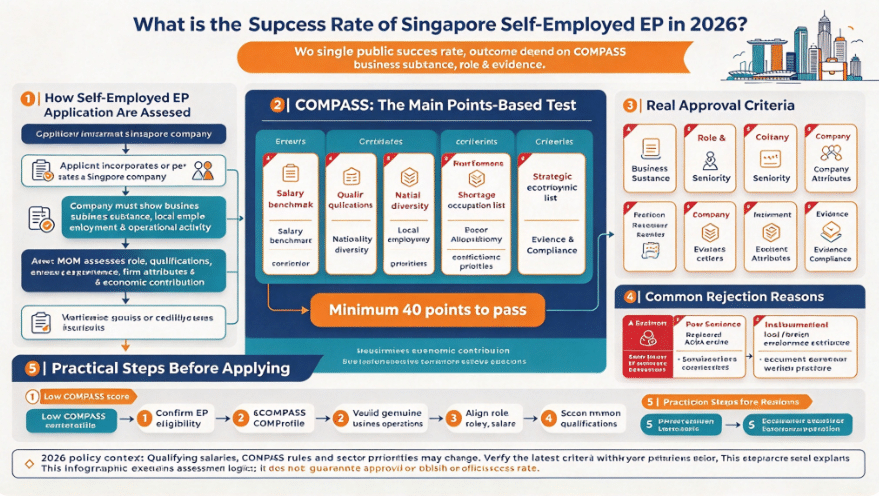
The 2026 official approval standards focus on three core dimensions. First, personal background consistency. The applicant’s past career experience, industry resources, and business scale must match the business scope of the newly registered Singapore company. If an applicant with no technology experience registers an AI technology company, or a traditional trader applies for a high-end consulting firm, the mismatch will directly lead to rejection. Second, business authenticity and sustainability. MOM examiners will evaluate whether the company has real market positioning, target customer groups, business cooperation possibilities, and local development value. Third, COMPASS framework performance. Applicants must meet the updated 2026 salary threshold and obtain qualified scores in salary benchmarking, educational background, industry contribution, and workforce diversity.
The most common rejection reasons in 2026 include empty business logic, template-based business proposals, unreasonable salary setting, disconnected personal experience, and zero local operation preparation. Many applicants only focus on company registration but ignore the pre-construction of business scenarios, resulting in low credibility during official review.
It is important to clarify that the Singapore self-employed EP does not have a fixed pass rate. Applications with real business support and compliant materials can achieve stable approval results, while purely packaged shell applications have almost zero passability. For entrepreneurs who want to legally layout Singapore business and obtain long-term residency qualifications, standardized business planning and compliant material preparation are the core of successful application.
If you are preparing for a Singapore self-employed EP application and want to avoid common rejection pitfalls, complete a professional background evaluation, and build a compliant business plan, you can consult Mayson. With rich local Singapore service experience, Mayson provides objective policy analysis, personalized business planning, and full-process application guidance to help applicants steadily pass official reviews.
FAQ
Q: Is Singapore self-employed EP still viable in 2026? A: Yes, but only for applicants with real industry experience and feasible business plans. Shell company applications are strictly banned.
Q: Does self-employed EP require local office space? A: Physical office space is not mandatory in the early stage, but measurable business preparation and operational awareness are required.