Most overseas Chinese families and cross-border entrepreneurs have invested years of effort to obtain Western permanent residency. Whether it is a US Green Card, Canadian PR, Australian PR or British settled status, these traditional Western residency statuses were once seen as the ultimate goal for overseas settlement. However, after years of living and working globally, a large number of overseas Chinese have discovered obvious structural drawbacks of Western PR: rigid immigration supervision days and heavy global tax obligations that restrict personal business development and family mobility.
The biggest pain point for overseas Chinese is the residency trap. Western immigration departments strictly enforce physical presence requirements. If you need to return to China for business development, take care of family affairs, or expand Asian market layouts, it is easy to fail to meet the annual residence days. Many overseas Chinese have faced the dilemma of “either abandon domestic business or risk losing PR status”. For cross-border groups whose business and social connections span China, Europe, America and Southeast Asia, this mandatory residency rule is extremely unfriendly and severely limits global mobility.
Global taxation is the second core pressure point. Almost all Western developed countries implement global tax systems. Once you hold local PR status, your worldwide income, including domestic business profits, Chinese real estate income, investment dividends and cross-border trade gains, must be fully declared. For overseas Chinese entrepreneurs with multi-country asset layouts and cross-border revenue sources, full declaration brings huge compliance pressure. Any omission or improper filing may trigger tax audits, fines and even affect immigration records and future visa applications.
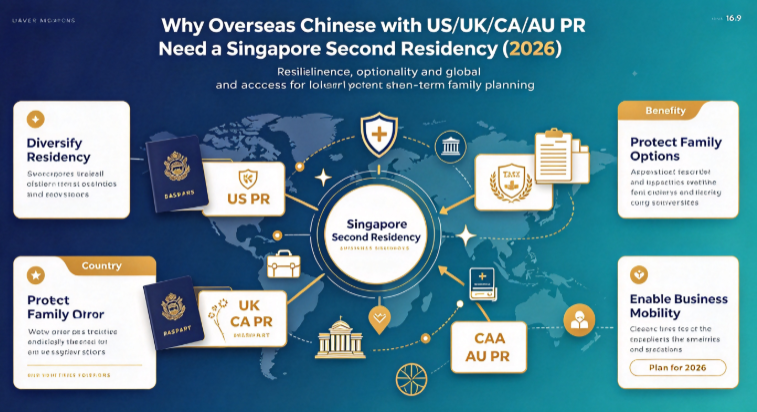
In contrast, Singapore’s residency system is tailor-made for globally mobile overseas Chinese. Singapore Employment Pass and PR schemes do not impose mandatory immigration supervision days. Overseas Chinese who already hold Western PR can legally retain their Singapore residency without being forced to stay in Singapore for a fixed number of days every year. They can continue to operate global businesses, travel frequently between China and Western countries, and maintain their original life and business layout without being restricted by rigid residency rules.
In terms of taxation, Singapore adopts a territorial taxation system, which is fundamentally different from global taxation. Only income generated in Singapore is taxable. Legitimate overseas income and offshore profits are exempt from double taxation. This policy effectively solves the tax dilemmas faced by overseas Chinese cross-border operators, optimizes global tax structure, and greatly reduces long-term compliance risks.
For overseas Chinese families with children’s education needs, Singapore’s bilingual education system fills the biggest gap in Western education. Children who grow up in a pure Western education environment often completely lose their Chinese language ability and cultural awareness, making it difficult to return to China for development in the future. Singapore’s English-teaching + compulsory Chinese curriculum allows children to integrate into international elite education while retaining Chinese cultural roots, enabling them to freely choose development paths in China, Western countries or globally.
The most critical advantage is status superposition. Singapore does not require applicants to abandon existing Western PR or citizenship. Overseas Chinese can perfectly realize dual-status layout: retaining Western settlement security while using Singapore’s flexibility to balance cross-border business, taxation and education. For overseas Chinese who have been drifting globally for a long time, Singapore is the most reliable soft landing and backup identity in 2026.
If you are an overseas Chinese holding Western PR, troubled by immigration days and global taxation, consult Mayson for a customized Singapore second residency solution for cross-border families.
FAQ
Q1: Can I apply for Singapore EP while holding Canada, Australia or US PR? A: Yes. Singapore allows multiple residency statuses with no conflict and no need to renounce existing status.
Q2: Will Singapore residency affect my Western permanent residency? A: No impact. The two systems are independent. Singapore provides flexible backup without interfering with your original settlement status.
Q3: Do I need to stay in Singapore regularly to maintain my EP? A: No mandatory stay requirement. Maintain valid business or family ties to keep the pass active long-term.