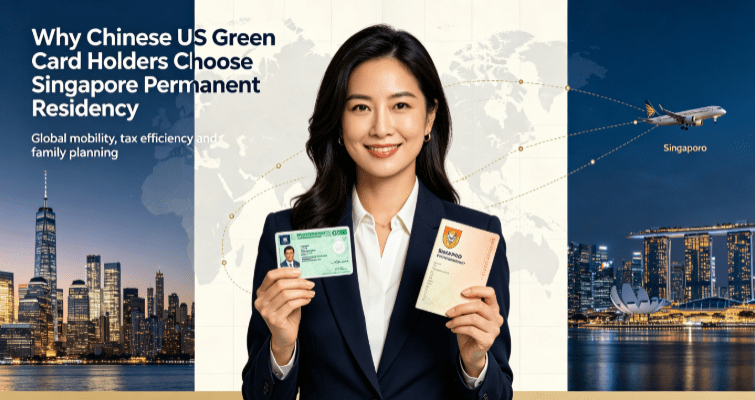
Many people wonder: already holding a US green card with permanent residency in the United States, why do numerous high-net-worth Chinese still apply for Singapore PR? This is not an either-or choice. Instead, it serves as a dual-status wealth planning strategy that balances Asian business operations, asset protection and cross-border mobility.
Once you obtain a US green card, you automatically become a US tax resident. Your worldwide income must be reported to the IRS. Capital gains and investment returns are subject to US tax rules. Should you decide to abandon your green card later, exit tax may apply, treating your global assets as sold and triggering heavy tax liabilities. This is the biggest concern for many green card holders.
Singapore adopts a territorial tax system. Only income sourced locally is taxable. There is no capital gains tax and no inheritance tax. Overseas investment income generally remains untaxed in Singapore, making it ideal for asset segregation and intergenerational wealth succession to build a solid foundation for family assets.
From a geographic and business perspective, the US is far from Asia with a large time difference. Many US green card holders still run core businesses and maintain social ties in China and Southeast Asia. Located at the heart of Southeast Asia, Singapore is merely a 2.5-hour flight away from China with almost no time difference. Mandarin is widely spoken, and its culture and cuisine resonate with Chinese communities. It acts as a stable foothold in Asia and compensates for the drawbacks of US residency for Asian business trips and family visits.
In terms of children’s education, while the US education system boasts obvious strengths, fierce competition and expensive private school fees are practical concerns. Singapore delivers world-class bilingual education. After securing Singapore PR, children can enrol in local public schools at much lower tuition fees compared with international students. Families gain two separate education pathways, preserving US study options while unlocking an alternative route for international admissions in Asia.
When it comes to global travel flexibility, a green card is only a US residence permit rather than a passport. You still need to apply for visas using your Chinese passport for overseas trips. If you later acquire a Singapore passport, you can enjoy visa-free access to more than 150 countries and regions, greatly facilitating international business travel. Singapore features social stability, sound legal frameworks, open financial markets and free foreign exchange. Its mature private banking and trust services support flexible deployment of global assets.
Important reminder: applying for Singapore status while retaining your US green card does not eliminate your US tax filing obligations. The requirement to report worldwide income to the US remains fully in force. You need professional cross-border tax planning in advance to avoid double taxation and reporting risks. Never rush into applications blindly.
Dual-status planning is not about giving up the US green card. It leverages Singapore residency to fill gaps in asset management, business development and Asian living arrangements, creating a status portfolio bridging East and West. Status planning represents a long-term family wealth strategy. Always evaluate your assets, tax situation and family needs thoroughly and engage qualified local professionals for implementation.
Mayson from Meisheng has years of experience specialising in Singapore immigration. With relevant qualifications recognised by MOM and ICA, we handle EP, PR, GIP and family office programmes. We provide end-to-end services including company registration, tax planning and relocation support, delivering compliant Singapore residency solutions for people holding overseas green cards.